


Summary
Roth conversions have become one of the darlings of financial planning discussions. The underlying thesis is generally sound: pay taxes at a lower rate on tax-deferred assets today in exchange for tax-free growth and withdrawals in the future. But with their growing popularity has come a tendency to oversimplify the strategy. Roth conversions are not one-size-fits-all, and whether a conversion ultimately creates value depends heavily on an individual’s tax situation and broader financial plan.
The key is determining whether paying tax today is likely to improve an investor’s long-term retirement and wealth transfer goals. More specifically, will future tax savings exceed taxes paid today?
Roth Conversions at a Glance
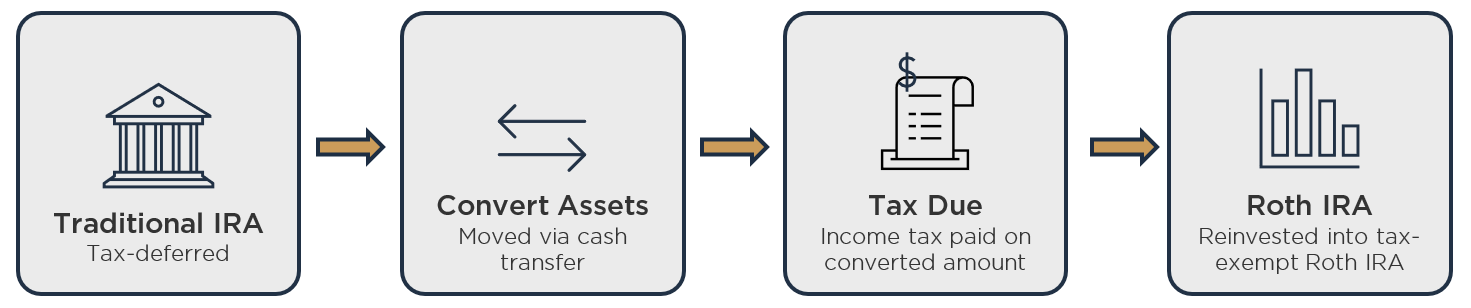
A Roth conversion is a transaction in which an investor converts tax-deferred retirement assets, most commonly from a Traditional IRA, into a Roth IRA. The taxable portion of the conversion is generally included in income for that year, while the converted assets can thereafter grow in the Roth IRA and potentially be withdrawn tax-free if applicable requirements are met.
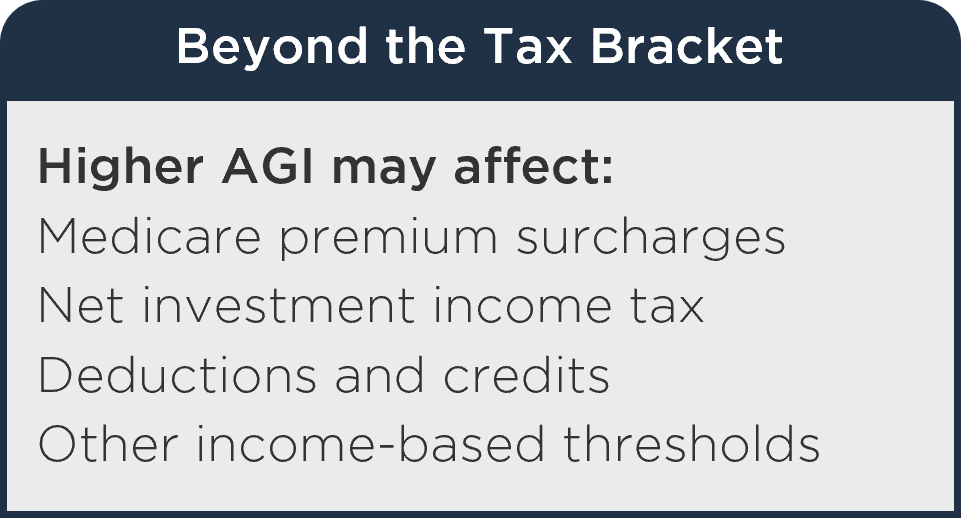
The impact of a Roth conversion can extend well beyond moving into a higher marginal tax bracket. Because a conversion generally increases adjusted gross income (AGI), it may also affect other taxes, premiums, deductions, credits, and income-based thresholds. These ripple effects can materially change the conversion’s true cost.
Understanding the Roth Conversion Opportunity
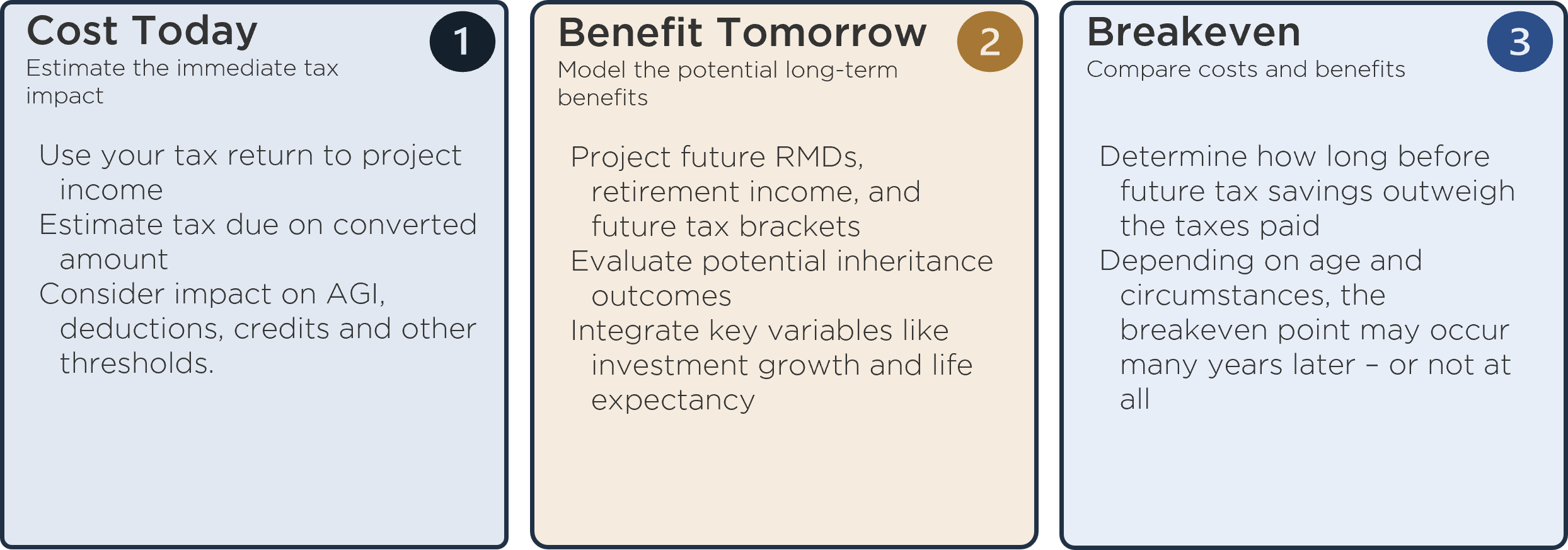
Every Roth conversion starts a race to breakeven. Reducing a future tax liability sounds attractive on the surface, but deeper analysis is needed to understand how changes in income interact with other planning variables. Paying tax earlier only creates value if the future tax savings eventually exceed the tax paid today. Depending on the investor’s age, tax rate, life expectancy, and future withdrawals, that breakeven point may occur many years later—or potentially after the investor’s lifetime.
Every Roth conversion starts a race to breakeven
In a perfect world, the conversion will both reduce future RMDs (Required Minimum Distributions) and provide a higher after-tax inheritance – but this is not a perfect world. Investors should understand that conversions may end up only benefiting their heirs and should decide if they are comfortable effectively pre-paying the tax for them today.
When Conversions Work
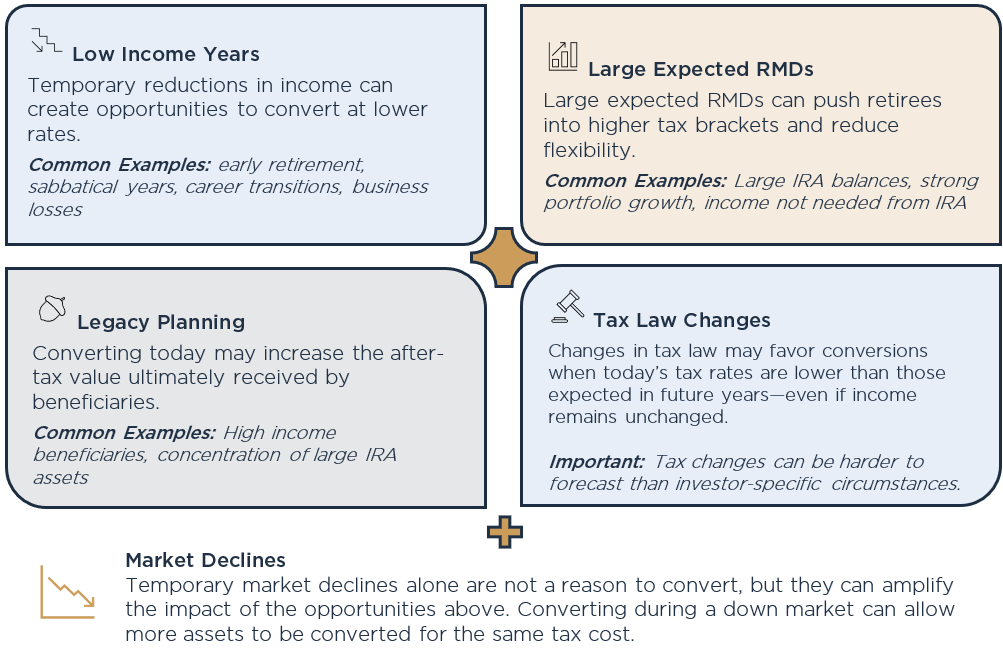
Conversions tend to be most attractive when an investor can recognize income at a lower effective cost today relative to the expected tax cost in the future. Several circumstances can create more favorable opportunities.
When Conversions Can Hurt
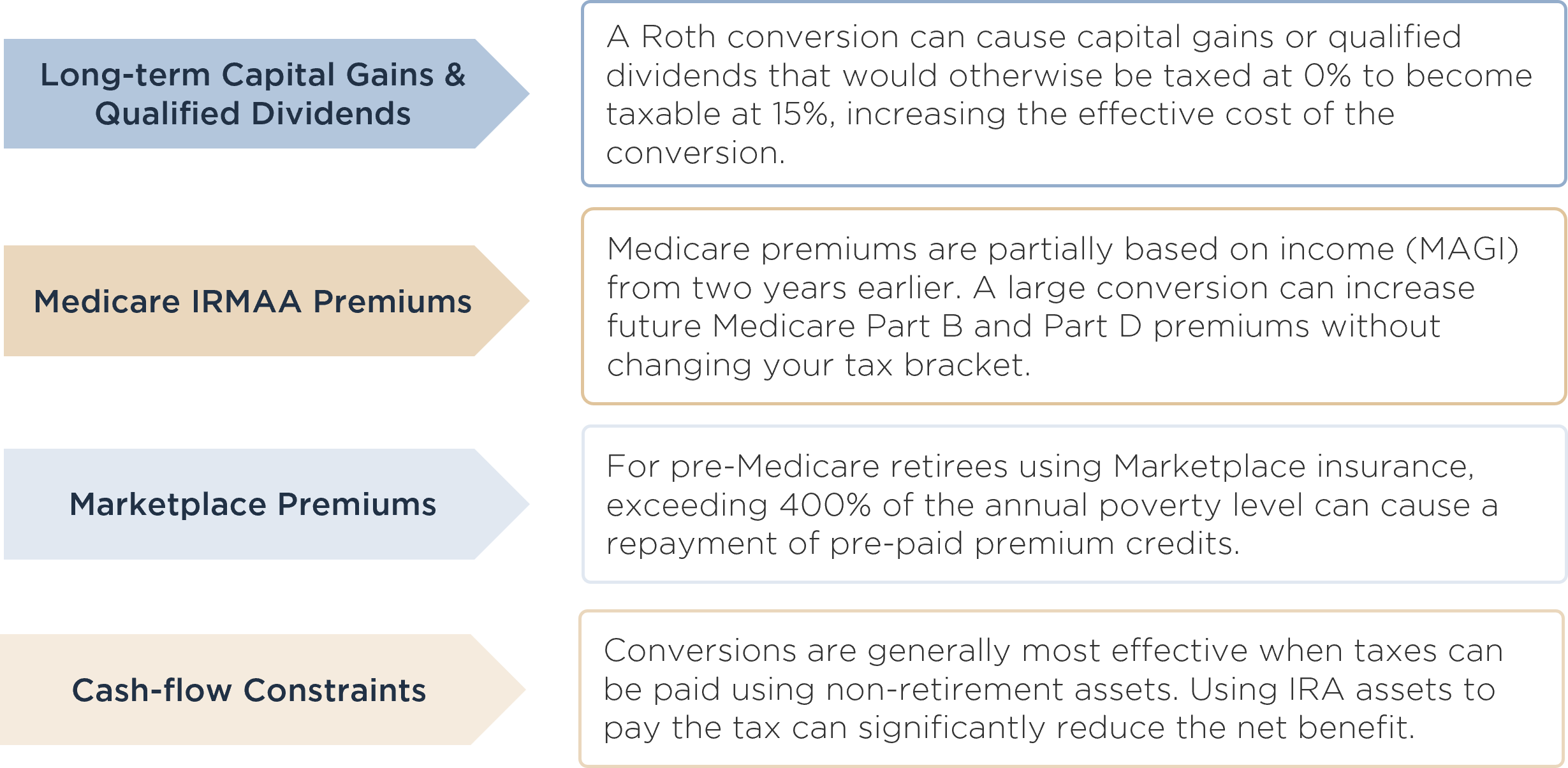
Roth conversions can create unintended tax consequences even when staying in the same ordinary income tax bracket. Additional income may trigger other taxes, premiums, phaseouts, or lost benefits that increase the conversion’s true cost.
How to Evaluate a Conversion
A Roth conversion is not just a current-year tax decision, but a long-term strategy. A thoughtful evaluation should compare the full cost today, the time required to reach breakeven, and the potential benefits tomorrow.
Coordinated Approach
Because Roth conversions can affect multiple areas of the tax equation, coordination between your financial advisor and tax professional is important. An advisor can model long-term retirement and estate implications, while a CPA can confirm the current-year tax impact prior to execution.
Our Perspective
Roth conversions can be a valuable tax-planning strategy, but they require a comprehensive cost-benefit analysis. Investors should compare the cost today with how, when, and to whom potential benefits may be received in the future. In some cases, thoughtful planning may ultimately lead to the decision not to convert at all. These decisions are best made within the context of a financial plan and with tools that can model how changes in income, tax rates, and future distributions may affect the outcome.
Trillium Perspectives are meant to provide practical context around the complex planning decisions investors face. By looking at tax, investment, retirement, and estate-planning decisions together, we aim to help clients make more informed decisions and coordinate those strategies with their other professional advisors when appropriate.
Have a Question?
Education is a core value at Trillium Wealth – as well-informed clients make the most confident decisions. Our team is well positioned to help you navigate complex investment, tax, and estate planning matters with practical insights and seasoned advisors.

Suken Jogani
Founder – Managing Director

Theodore (TJ) Zak, CFP®, AIF®
Founder – Managing Director

Anthony Juliano, CFP®
Founder – Wealth Advisor
Trillium Wealth nor &Partners renders legal or tax advice. Please consult your tax or legal advisors before taking any action that may have tax consequences. &Partners is the enterprise trade/marketing name for Ampersand Partners LLC, a Delaware limited liability company, and its subsidiary, &Partners, LLC, a Tennessee limited liability company registered with the U.S. Securities and Exchange Commission as a broker-dealer and investment adviser. Securities and investment advisory services offered through &Partners, LLC, member FINRA and SIPC.


